I hate when this happens. You've been warned.
This weekend I caught a showing of Stargate on cable. It's one of my all time favorite movies and despite the regurgitated syndication of television shows it remains a solid science fantasy movie. Even after 15 (yup) years it still holds up a well produced film.
But there's a plot hole I never saw until just now.
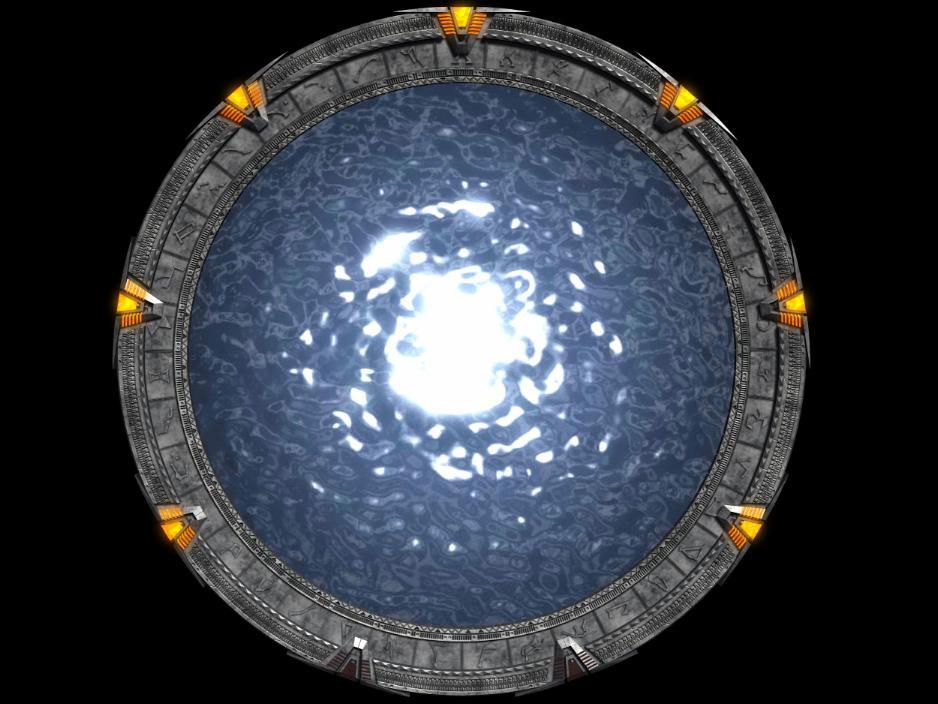
For those who haven't seen it (and seriously, how can you be using a computer, the internet or breathing if you haven't) the story revolves around an unearthed piece of ancient technology that opens travel between star systems. A scientist and a group of soldiers take the first ride to a planet on the other side of the galaxy where they find a civilization much like ancient Egypt. It turns out, Ra - the sun god - was an alien. (Later in the television shows he is shown to be of a race called the Ancients. How droll.) This alien used the uncivilized humans to create an empire for himself, essentially creating civilization on Earth. This proves the scientist's theory that the pyramids were created by aliens.
Ra's slaves revolted and he fled, but he created (or planted) a stargate on Earth and then kidnapped a few thousand humans. On this new planet, Ra outlawed reading and writing to avoid another revolt, but when the scientist and soldiers show up, the slaves revolt again and this time Ra isn't able to run.
It's a neat story, but there's a problem with the technology.
The gate contains 39 symbols or chevrons. It spins around on a free wheel and uses 7 locking mechanisms to hold selected symbols in place. Once you put in the seven correct symbols, the gate opens and you can walk through it to the new location. The way it's described in the movie is problematic in that the scientist says you need seven points to plot a course through space; six for a destination and one for the starting point. There was a cover stone with six symbols on it, but the original team couldn't figure it out until the scientist came in and figured out that the symbols are all star clusters - constellations. The seventh symbol, the point of origin, was a representation of Earth.
Ok, it kind of makes sense if you're watching and aren't thinking about it too much. But I did start thinking and here's my problem.
First: Now I could be wrong on this, but I thought you only needed three "points" to plot a point in space. The intersection of the lines drawn from an X a Y and a Z intersect to give you a point. On a plane this is triangulation, so I'm assuming someone smarter than me looked up how to go about doing this in 3 dimensions. But this leads to my second problem.
You have to use spatial coordinates to plot anything. If I was using the methodology from the movie, I'd have to know six distinct coordinates, which are usually of an X, Y, and Z variety. So that's 18 numbers already, but where am I measuring FROM? On Earth we coordinate using established longitude and latitude lines, and we only need two numbers. But in space are we measuring from Earth? The Sun? The center of the universe? There's a great article on how the TARDIS from Doctor Who moves through space (and time) but I won't get into it here. Needless to say, it's starting to get dodgy because without a frame of reference, even the six points I need to use to find another point are in question. So what do I use? What happened here is whoever wrote and finalized the script wanted to use symbols. It allowed an ancient language expert to join a military venture. So the symbols were tied to star clusters and with out suspension of disbelief, we were baited and switched over the facts that coordinates equal star clusters equal symbols. Symbol one is Orion which is x28, y105 and z254.
Point the third: Even if the coordinate you used was a single star IN that constellation, that star moves. Gates (for the most part) are on planets that move around a star that move within a galaxy that hurtles through the universe. So let's assume you've rationalized the coordinates being a star cluster and that each on is represented by the cluster's dominate star, it would be like plotting a point in your backyard using moths; it'll never be the same. This led me to believe that the symbols are not coordinates at all, but an address. It seems more likely that you could use a group of symbols to find almost a postal location. The gate is there and has a dialing or mailing code so you use other gates to find it. My house doesn't move in relation to other houses in the eyes of the postal service, so sending it to 123 Main St. Austin, TX, 78701 USA will always get it to the right place, no matter how fast you and I plunge through the cosmos. So, we can equate the 7 symbols to and address. That's easier right?
Not so fast, Dr. Jackson. Here is my final point and the one that can't really be resolved. In order to travel to another place, I'm giving you six symbols, based on my location, to represent where I'm going AS WELL AS a seventh symbol representing where I am. Let me say that again using the mailing address analogy. I'm going to mail a package from Austin to Dallas. In order to know where to drive, I need an address. The address is a street number, street name, zip code, city, state, country. Six symbols, right? The seventh is my point of origin. The package is GOING to Dallas, it doesn't need to know my current location to get there, so it's 7th symbol will be "mailbox." Ok, so using the Stargate method of travel, I'd tell my package where to go by addressing it based off things only I can see from Austin (star constellations only I can see from Earth.) If I looked north toward Dallas, I'd see a couple clouds, a building, maybe a few cars. So I'd address my package, "To: Big cloud, little cloud, bank, Chevy, overpass, jogger. From: Me."
That's what Stargate is doing.
It's telling us this gate can open a wormhole to another place by giving it directions to ourselves. The star constellations only make sense if you're on Earth, if you're using them as an address and not coordinates. If you're using coordinates, it only works if you account for drift and a known center of the universe. In short, it doesn't work either way.
Not to mention the fact that if you're using the number of symbols on the wheel as a method of "dialing" a location, you'd be trying forever to figure something out. I used an online permutation calculator so I can't claim my alegebra is right, but of 39 symbols, using 6 as a subset (assuming 1 never changes as a point of origin) you have 137,231,006,679 possible destinations. They explored that in the show and alluded to the idea that there are gates almost everywhere in the universe, but at this point I think they're method for dialing is flawed.
See what happens when I get an itch on my brain like that? You were warned.


